Thursday, 1 October 2015

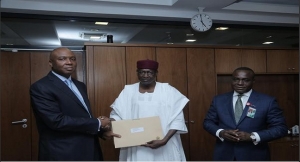
Saraki recieves ministerial list
Dr saraki has no plan to open the envelope until Tuesday, Yusuph Olaniyonu, special adviser to the Senate President on media and publicity, said today.
“Dr. Saraki has, following the tradition of the Senate, decided that the envelope will remain sealed till Tuesday October 6, when during the plenary sitting of the Upper legislative chamber, it will be opened and the list read to Senators”, Olaniyonu wrote in a statement.
Wednesday, 30 September 2015
Ministerial List: President Buhari appoints self as Petroleum Minister
Lagos (AFP) – Nigeria’s President Muhammadu Buhari is to take personal charge of the country’s crucial oil portfolio, his spokesman said on Tuesday, as a deadline loomed for him to finally nominate his cabinet.
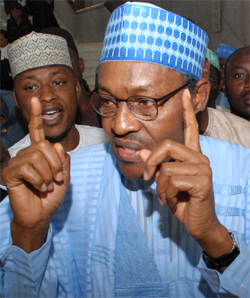
Buhari
Reports from New York, where Buhari has been attending the UN General Assembly, quoted the president as saying he would be minister of petroleum resources, with a junior minister taking charge of day-to-day affairs in the sector.
“Confirmed. He said so,” his spokesman Femi Adesina told AFP in a text message, without giving further details.
Buhari, 72, took office on May 29 after a landmark election victory against Goodluck Jonathan — the first time an opposition candidate has unseated an incumbent in the country’s history.
The former military ruler has vowed that corruption and the corrupt will have no place in his government and vetting of potential candidates has been seen as delaying his appointment of a senior ministerial team.
Buhari has made tackling the rot in the oil sector a priority, as he seeks to cut endemic graft and put the country’s crippled, crude-dependent finances on a firmer footing.
Nigeria — Africa’s number one crude producer and biggest economy — has been hit badly by a slump in global crude prices since last year, squeezing government revenue.
Oil accounts for some 90 percent of Nigeria’s foreign exchange earnings.
The president has vowed to recover “mind-boggling” sums of stolen oil cash, starting with a drastic overhaul of state-run oil firm the Nigerian National Petroleum Company (NNPC).
The NNPC has become a byword for corruption and last year was accused of failing to remit $20 billion in revenue to the central bank.
Buhari helped establish the NNPC in 1977 as oil minister under military ruler General Olusegun Obasanjo.
He was later in charge of the Petroleum Trust Fund during the time of General Sani Abacha in the 1990s.
Buhari’s caution in appointing ministers has seen him nicknamed “Baba Go Slow” in Nigeria, but he has promised to name his cabinet by Wednesday.
Appointments have to be approved by parliament, which resumed sitting on Tuesday.
A committee advising Buhari on policy before he took office has recommended he streamlines the number of ministries and ministers.
Meanwhile, according to the Senior Special Assistant (SSA) on Media and Publicity to the President, Garba Shehu, President Buhari on Wednesday, departed the United States for Abuja after a successful outing at the 70th session of the UN General Assembly in New York.
HERDSMEN FROM HELL by Femi-Fani Kayode
“Throughout history, it has been the inaction of those who could have acted, the indifference of those who should have known better and the silence of the voice of justice when it mattered most that has made it possible for evil to triumph”- His Royal Majesty Haile Selassie 1, Emperor of Ethiopia.
If there was ever a time to remember the words of Haile Selassie and speak out against evil, this is it. With the abduction of the elder statesman and June 12th struggle hero, Chief Olu Falae, from his home by a group of Fulani herdsmen in south western Nigeria, it is time for us to seriously consider the expulsion of all Fulani herdsmen from the southern part of our country.
We thank God and commend the efforts of the Inspector-General of Nigerian Police that Chief Falae was returned home safely after a harrowing three days. Given his status in Yorubaland, had this not been so, there would have been cataclysmic consequences for the unity of our country.
It is because we wish to avoid such a scenario that it is important that we get these marauders and vandals out of our territory as quickly as possible. This is especially so given the fact that, by Falae’s testimony, it is clear that the Fulani herdsmen that abducted him were working hand in hand with Boko Haram.
These herdsmen have become the pests of our nation. They are like the east African tsetse fly: wherever they go they suck the life blood out of their hosts and, like the locust, they destroy everything in their path. They are like leeches: they indulge in a parasitic mode of nutrition and they suck the blood of the carcass until their victim is left for dead.
Like the Arab Janjaweed, they are only known for the most hideous of things. This includes terror, intimidation, theft, murder, rape, abduction, mutilation, the violation of the rights of others, the destruction of the land and crops of farmers and the destruction of property.
Anyone that doubts this should ask the people of the north central zone what they have been suffering in the hands of these vagabonds and vagrants for the last 50 years. This is especially so in Plateau, Benue, Niger, Kwara, Nassarawa, Taraba and Adamawa states.
Yet up until 20 years ago this was essentially a northern problem and it did not affect the south. Sadly that has changed. It has now become a national plague that knows no boundaries and whose poison threatens to consume us all.
In the last few years the Fulani herdsmen have attacked, ravaged and pillaged many rural communities south of the River Niger and they have slaughtered and raped thousands of innocent people in the south-south, the south-east and the south-western zones of our country.
We recall how, after a violent clash between them and some Yoruba farmers in Oyo state in 2000, General Buhari (as he then was) led a strong delegation of northern leaders to see the late Governor of Oyo state, Governor Lam Adeshina. On arrival, Buhari put the following question to him: “why are YOUR people killing MY people?” This was a classic case of a Freudian slip. The Bible says ‘’out of the abundance of the heart, the mouth speaks’’. The general had spoken his mind.
Governor Adeshina was shocked with disbelief and he responded by telling Buhari that he was rather surprised that a former Head of State would refer to one ethnic group as “his’’ people whilst referring to another as someone elses’. He said that this was especially so given the fact that people were killed on both sides of the divide in what was a sad and unfortunate conflict.
The insensitivity of Buhari to the Yoruba farmers and their plight in the hands of the Fulani raiders was noted from that moment on. Ever since that conversation took place, the lines have been drawn and the South west has been on the alert.
The abduction of Falae may well have brought things to a head because today, virtually every self-respecting Yoruba man is calling for strong resistance to these alien cattle-rearers whose criminal activities have led to nothing but blood, tears and carnage. If government refuses to stop them then it is very clear that some communities may end up doing so themselves.
Yet, there is an even more sinister dimension to this problem than most people care to admit. That dimension is best illustrated by the following question. Can there be any truth in the assertion that the Fulani herdsmen are nothing less than the vanguard and covert armed wing of the Fulani ruling class which has managed to infiltrate the south under the ingenious guise of selling cows?
Are they sleeper cells of a much bigger army and a much wider cause? Are they, as Falae has suggested, working hand-in-hand with Boko Haram? If a major conflict were to arise, would those sleeper cells be activated and would they commence the wholesale slaughter of the indigenous population in their host states? As painful as it may appear, these are questions that we must ask.
The fact that the herdsmen demanded for a 100 million naira ransom from Falae speaks volumes. The question is this: what do mere cattle-rearers want with 100 million naira? Even more instructive is the fact that when they were offered 2 million naira they responded by saying that that amount would not be enough for Boko Haram.
Given all these, it is clear to me that we must begin to look at the wider picture. We must accept the ugly reality that there may be more to all these than meets the eye. This is especially so, given the fact that until the time of writing this piece, not one of Falae’s captors has been apprehended by the Police and they seem to have vanished into thin air. One wonders what transpired. Were they granted amnesty or are they ghosts?
Can there be any truth in the suggestion that there was a kind of official collusion in the abduction? Was it an attempt to put Falae, and by extension the Yoruba, in their place for vigorously supporting the idea of a national conference? Is it an attempt to intimidate those from the south west that opposed President Buhari in the 2015 presidential elections? If so, it will not work.
Afenifere, the leading socio-cultural group of the south west of which Falae is a leading member, and the Yoruba people generally have a way of rising to the occasion when they are threatened, cheated or persecuted. History proves that. Worthy of note are the words of Dr. Frederick Fasheun and Otunba Gani Adams, both leaders of the Odua Peoples Congress (OPC) in this matter. Only the unwise would ignore their counsel.
Another curious twist to the tale is the fact that it took the Buhari administration two days to make a formal announcement on Falae’s abduction and just the day after they finally did so, the elder statesman was suddenly released.
The question is this: who is pulling the strings from behind the scenes and who is attempting to test our resolve and test the waters? Whatever the answer to these questions are, one thing remains clear. The days of killing people with impunity and stripping them of their lands and possessions are long over.
The Fulani herdsmen may well believe that they have one of their own in the Villa today but that does not mean that they will get away with their murderous ways or their sheer impunity. It is most unwise for them to continue to test the resolve of the people of the south in this way. I say this because collectively, southerners are slow to anger but irresistible in battle. When pushed to the wall they often indulge in what Dr. Amanze Obi, the respected columnist for Nigeria’s Sun newspaper, once described as ‘’southern fury’’.
Permit me to conclude this intervention with an interesting and relevant contribution from the famous British historian, writer and educationalist Dr. T.R. Batten. He wrote:
“The Fulani were at their most, influential in Gobir. Then a dispute broke out between their Imam, Usman Dan Fodiyo and Sarkin Gobir Yunfa.The Fulani rallied behind their leader who encouraged them to defy their Hausa Chief. He began a jihad and fighting broke out. Thus, the Fulani seized the country by force against the will of those who lived there. The enmity had nothing to do with religion for among those who fought (against the Fulani) were many Muslims. It was about the Fulani’s wish to seize power from the Hausas.”
It follows that the herdsman and those that they represent conquer by infiltration, assimilation and guile. Those that doubt this should find out what became of the ancient Hausa kingdoms. May God deliver us from the vagabonds and vagrants in our midst.
If there was ever a time to remember the words of Haile Selassie and speak out against evil, this is it. With the abduction of the elder statesman and June 12th struggle hero, Chief Olu Falae, from his home by a group of Fulani herdsmen in south western Nigeria, it is time for us to seriously consider the expulsion of all Fulani herdsmen from the southern part of our country.
We thank God and commend the efforts of the Inspector-General of Nigerian Police that Chief Falae was returned home safely after a harrowing three days. Given his status in Yorubaland, had this not been so, there would have been cataclysmic consequences for the unity of our country.
It is because we wish to avoid such a scenario that it is important that we get these marauders and vandals out of our territory as quickly as possible. This is especially so given the fact that, by Falae’s testimony, it is clear that the Fulani herdsmen that abducted him were working hand in hand with Boko Haram.
These herdsmen have become the pests of our nation. They are like the east African tsetse fly: wherever they go they suck the life blood out of their hosts and, like the locust, they destroy everything in their path. They are like leeches: they indulge in a parasitic mode of nutrition and they suck the blood of the carcass until their victim is left for dead.
Like the Arab Janjaweed, they are only known for the most hideous of things. This includes terror, intimidation, theft, murder, rape, abduction, mutilation, the violation of the rights of others, the destruction of the land and crops of farmers and the destruction of property.
Anyone that doubts this should ask the people of the north central zone what they have been suffering in the hands of these vagabonds and vagrants for the last 50 years. This is especially so in Plateau, Benue, Niger, Kwara, Nassarawa, Taraba and Adamawa states.
Yet up until 20 years ago this was essentially a northern problem and it did not affect the south. Sadly that has changed. It has now become a national plague that knows no boundaries and whose poison threatens to consume us all.
In the last few years the Fulani herdsmen have attacked, ravaged and pillaged many rural communities south of the River Niger and they have slaughtered and raped thousands of innocent people in the south-south, the south-east and the south-western zones of our country.
We recall how, after a violent clash between them and some Yoruba farmers in Oyo state in 2000, General Buhari (as he then was) led a strong delegation of northern leaders to see the late Governor of Oyo state, Governor Lam Adeshina. On arrival, Buhari put the following question to him: “why are YOUR people killing MY people?” This was a classic case of a Freudian slip. The Bible says ‘’out of the abundance of the heart, the mouth speaks’’. The general had spoken his mind.
Governor Adeshina was shocked with disbelief and he responded by telling Buhari that he was rather surprised that a former Head of State would refer to one ethnic group as “his’’ people whilst referring to another as someone elses’. He said that this was especially so given the fact that people were killed on both sides of the divide in what was a sad and unfortunate conflict.
The insensitivity of Buhari to the Yoruba farmers and their plight in the hands of the Fulani raiders was noted from that moment on. Ever since that conversation took place, the lines have been drawn and the South west has been on the alert.
The abduction of Falae may well have brought things to a head because today, virtually every self-respecting Yoruba man is calling for strong resistance to these alien cattle-rearers whose criminal activities have led to nothing but blood, tears and carnage. If government refuses to stop them then it is very clear that some communities may end up doing so themselves.
Yet, there is an even more sinister dimension to this problem than most people care to admit. That dimension is best illustrated by the following question. Can there be any truth in the assertion that the Fulani herdsmen are nothing less than the vanguard and covert armed wing of the Fulani ruling class which has managed to infiltrate the south under the ingenious guise of selling cows?
Are they sleeper cells of a much bigger army and a much wider cause? Are they, as Falae has suggested, working hand-in-hand with Boko Haram? If a major conflict were to arise, would those sleeper cells be activated and would they commence the wholesale slaughter of the indigenous population in their host states? As painful as it may appear, these are questions that we must ask.
The fact that the herdsmen demanded for a 100 million naira ransom from Falae speaks volumes. The question is this: what do mere cattle-rearers want with 100 million naira? Even more instructive is the fact that when they were offered 2 million naira they responded by saying that that amount would not be enough for Boko Haram.
Given all these, it is clear to me that we must begin to look at the wider picture. We must accept the ugly reality that there may be more to all these than meets the eye. This is especially so, given the fact that until the time of writing this piece, not one of Falae’s captors has been apprehended by the Police and they seem to have vanished into thin air. One wonders what transpired. Were they granted amnesty or are they ghosts?
Can there be any truth in the suggestion that there was a kind of official collusion in the abduction? Was it an attempt to put Falae, and by extension the Yoruba, in their place for vigorously supporting the idea of a national conference? Is it an attempt to intimidate those from the south west that opposed President Buhari in the 2015 presidential elections? If so, it will not work.
Afenifere, the leading socio-cultural group of the south west of which Falae is a leading member, and the Yoruba people generally have a way of rising to the occasion when they are threatened, cheated or persecuted. History proves that. Worthy of note are the words of Dr. Frederick Fasheun and Otunba Gani Adams, both leaders of the Odua Peoples Congress (OPC) in this matter. Only the unwise would ignore their counsel.
Another curious twist to the tale is the fact that it took the Buhari administration two days to make a formal announcement on Falae’s abduction and just the day after they finally did so, the elder statesman was suddenly released.
The question is this: who is pulling the strings from behind the scenes and who is attempting to test our resolve and test the waters? Whatever the answer to these questions are, one thing remains clear. The days of killing people with impunity and stripping them of their lands and possessions are long over.
The Fulani herdsmen may well believe that they have one of their own in the Villa today but that does not mean that they will get away with their murderous ways or their sheer impunity. It is most unwise for them to continue to test the resolve of the people of the south in this way. I say this because collectively, southerners are slow to anger but irresistible in battle. When pushed to the wall they often indulge in what Dr. Amanze Obi, the respected columnist for Nigeria’s Sun newspaper, once described as ‘’southern fury’’.
Permit me to conclude this intervention with an interesting and relevant contribution from the famous British historian, writer and educationalist Dr. T.R. Batten. He wrote:
“The Fulani were at their most, influential in Gobir. Then a dispute broke out between their Imam, Usman Dan Fodiyo and Sarkin Gobir Yunfa.The Fulani rallied behind their leader who encouraged them to defy their Hausa Chief. He began a jihad and fighting broke out. Thus, the Fulani seized the country by force against the will of those who lived there. The enmity had nothing to do with religion for among those who fought (against the Fulani) were many Muslims. It was about the Fulani’s wish to seize power from the Hausas.”
It follows that the herdsman and those that they represent conquer by infiltration, assimilation and guile. Those that doubt this should find out what became of the ancient Hausa kingdoms. May God deliver us from the vagabonds and vagrants in our midst.
Tuesday, 21 July 2015
Obama woos Nigeria's Buhari after historic election
Washington (AFP) - Barack Obama welcomed Nigeria's freshly elected president to the White House on Monday, lending a personal endorsement after the country's first ever democratic transition.
Obama praised the March vote as "an affirmation of Nigeria's commitment to democracy."
He said the people of the oil-rich and diverse nation "understand that only through a peaceful political process can change take place."
Obama -- facing criticism for not including the continent's most populous country and biggest economy on a Africa tour later this week that will take in Kenya and Ethiopia -- turned on the charm, lavishing praise on the former military ruler.
"President Buhari comes into office with a reputation for integrity and a very clear agenda," he said.
"And that is to make sure that he is bringing safety and security and peace to his country."
Buhari reciprocated the praise, saying US pressure helped ensure the elections were "free, fair and credible."
"We will ever be grateful," he said.
- Tough task ahead-
But Buhari, who ruled as a military strongman between 1983 and 1985, returns to office facing a Boko Haram insurgency that has resulted in the deaths of at least 15,000 people and displaced 1.5 million.

US President Barack Obama (R) shakes hands with Nigerian President Muhammadu Buhari during a meeting …
Since 2009 the group has been trying to establish an Islamic state in northeast Nigeria.
Buhari's visit was foreshadowed by a uptick in terror attacks, including suicide bombings in neighboring Cameroon and Chad.
Rights groups say atrocities have been committed both by Boko Haram and the Nigerian military.
US laws banning the transfer of weapons to countries suspected of rights abuses have sometimes pushed a wedge between the two allies.
Obama's administration last year blocked the sale of Cobra attack helicopters to Nigeria, hampering cooperation amid efforts to find the hundreds of still-missing kidnapped Chibok schoolgirls.
Since being elected in May, Buhari has indicated a readiness to address problems in the army he once ran as a general and as Nigeria's military ruler.
Earlier this month Buhari sacked his entire military top brass.
Buhari's purge of senior commanders inherited from his predecessor Goodluck Jonathan was widely expected but is the clearest demonstration yet of his quest for a fresh start.
Obama said successful reforms would mean that "Nigeria ends up being an anchor, not only of prosperity and stability" but, he said, the country "can also be an outstanding role model for developing countries around the world."
Obama said he ready to discuss "how we can be helpful" in addressing the issues that have held Nigeria back.
Still, he is unlikely to endorse a dramatic ramping up of US military activity against Boko Haram -- fearing it could be used by the group as a recruiting tool and entangle the United States in yet another conflict.
Saturday, 9 May 2015
How We Failed the Lost Girls Kidnapped by Boko Haram
We were fascinated with the search for the Malaysian plane and the search for survivors on the South Korean ferry. Why wasn't the media also focused on searching for the missing girls?
In a speech on national television Sunday, almost three weeks after the girls were taken, Nigerian President Goodluck Jonathanvowed to rescue the missing schoolgirls and bring them home to their families. On Monday, a Boko Haram leader released a video claiming responsibility, saying “I abducted your girls” and “I will sell them in the market, by Allah.”
There’s nothing the media loves more than a good hunt. So for the past few months, news coverage has been dominated by the hunt for the missing Malaysia Airlines Flight MH370, the hunt for survivors on the South Korean ferry accident, even the hunt for the U.S.’s 2016 presidential candidates. But when Boko Haram terrorists kidnapped more than 276 Nigerian girls from their school on the night of April 14, Wolf Blitzer and his fancy graphics were nowhere to be found.
Eighteen days ago, the girls were just high schoolers trying to get an education. Now they’ve been kidnapped by terrorists and likely soldinto “marriages” to men in Chad and Cameroon.
Sister Rosemary Nyirumbe, who runs a shelter for girls abducted by Joseph Kony’s rebel group, the Lord’s Resistance Army, in Uganda, says that’s just a euphemism for systematic rape. “This is not marriage,” she says. “They are being given in sex slavery. This is human trafficking. We should call evil by its name.” Sub-Saharan Africa is home to over 16% of the 29.8 million enslaved people in the world, and now these girls have likely joined their ranks.
It’s atrocious that the Nigerian government has made almost no publicized effort to find the girls. Mausi Segun, a researcher for Human Rights Watch in Nigeria, says that people who live near the group’s suspected camps haven’t seen any security forces searching for the students, nobody from the government has reached out to the families, and the government even lied and said that most of the girls had been returned.
But the media enabled the government to sweep the whole thing under the rug by ignoring the story for weeks. The kidnapping was mentioned for the first time on American nightly news on May 1, more than two weeks after the girls were taken, according to Andrew Tyndall, who runs the Tyndall Report analyzing TV news. NBC Nightly News ran the first story Thursday night, CBS ran a pieceFriday morning, and ABC has been mum. The story never made the front page of the national edition of the New York Times. CNN has had a bit more coverage, but nothing approaching the coverage of the missing Malaysia Airlines plane carrying 370 passengers or the South Korean ferry accident that left over 300 people dead or missing. We only started paying close attention after salacious rumors surfaced that the girls were likely sold as child brides for as little as $12. That’s too little, too late.
By contrast, when the Malaysia Airlines jet disappeared March 8, the story was the lead story on all NBC, ABC and CBS news shows for 11 weekdays straight.
But does it matter what’s on TV?
Nyirumbe says global media attention is key to stopping the atrocities. “The media has the most powerful voice, the media can reverse evil if it is done correctly,” she says. “Even these people who are doing these atrocities against humanity, once they hear the media is coming, they stop.”
The irony is that by Netflix-algorithm logic, this should have been the biggest news of the past two weeks — stories about searches, schools and sexual abuse tend to capture our interest. Tyndall points out that the media tends to love stories about girls’ education in Muslim countries; just look at all the press Malala Yousafzai has gotten (she now has a publicity team to handle her public image).
The girls were kidnapped by Islamic extremist group Boko Haram on the night of they’d assembled to take an exam at the Government Girls Secondary School in Chibok, in the northeastern part of the country. That’s no coincidence, because Boko Haram’s name roughly translates to “Western education is forbidden.” The group has been terrorizing Nigeria for years, capitalizing on instability fueled by economic inequality and unemployment in Africa’s largest economy. They’ve attacked villages, caused explosions at bus stations andmurdered boys at a boarding school, but this is their largest attack yet, the one that should have caught the world’s attention.
Frustrated by the government’s lack of action, some of the girls’fathers and brothers have gone looking for them, without success. It’s possible (but unlikely) that the government is doing some behind-the-scenes negotiations for the girls’ rescue, but the families are still protesting that the government isn’t doing enough to help the lost girls.
The issue will be harder to ignore when representatives from other nations descend on Nigeria this week for the World Economic Forum. Nigeria just became Africa’s biggest economy, and the government wants to be associated with growth and opportunity, not terrorism and corruption. This mass kidnapping is bad optics for the narrative of a Nigeria on the rise, which is why they tried to bury the story.
Segun, of Human Rights Watch, says that the government’s lie that the girls were returned was partially intended to deceive the media. “The government is concerned about its image, and a lot of what happened initially was that to stave off that interest,” she says, adding that the government pressured the school principal to back up their story, but she refused.
But why did it take the press so long to catch on?
Because we have a tendency to overreport stories that affect our foreign policy (especially in India, China and the Middle East) and underreport stories that have less geopolitical relevance. There’s also the fact that most foreign bureaus have been decimated, and 20 newspapers and companies have eliminated their foreign bureaus since 1998, which means that facts about the kidnapping were hard to come by. And it’s impossible to ignore the racial implications: when a pretty blonde girl like Hannah Anderson or Elizabeth Smart goes missing, news outlets send helicopters and reporters to the scene; but when hundreds of black girls are kidnapped in a faraway country, it barely makes the news.
Now the spotlight on this case has grown, perhaps because of the impending economic forum. But it almost doesn’t matter what finally got the world’s attention because the media scrutiny came far too late. Two weeks ago the girls were taken in a caravan that moved slowly enough that some girls were able to escape. If we had paid attention then, when the girls were together and still in the country, they might have been found.
Of course Boko Haram are the villains here, and the Nigerian government bears the brunt of the blame for the lack of action. However, this tragedy is partly on us. We weren’t paying attention. We failed those girls. Let’s not do it again.
Ways to grow longer hair

The most widely known fact about black hair is that it does not grow or recover fast from any damage.Black hair in some places is regarded as rubbish or unacceptable “just manageable”.That is absolutely not right. In this post, I’ll prove them wrong.I:’ll teach you how to grow your hair longer.
#1. Healthy lifestyle
Many people will be wondering what your hair has to do with a healthy lifestyle? Your hair has everything to do with a healthy lifestyle. What you eat, drink and how you treat your body affects your hair. You need fruits, vegetables,exercise and water to enhance overall body performance. When you have a good health status, every part of your body would benefit. Making your nails your teeth even your hair benefit, because your hair grows directly from your body.

#2. Use MOISTURIZERS
Almost always, black hair is found dry.A moisturizer is needed to replace the needed moisture. With conditioners applied, the hair is given adequate support to grow and look fresh. Don’t be selfish to buy substandard ones because they are cheap, it is useless. Look for the best if possible, use it always without changing products. This will make your hair to be famliar with it.

Almost always, black hair is found dry.A moisturizer is needed to replace the needed moisture. With conditioners applied, the hair is given adequate support to grow and look fresh. Don’t be selfish to buy substandard ones because they are cheap, it is useless. Look for the best if possible, use it always without changing products. This will make your hair to be famliar with it.
#3. TRIM YOUR HAIR
Averagely, women’s hair grow at the rate of 1/2 inch per month. And when some hear you say trim your hair, they would be like” I’ll make my hair shorter”With time, the end would begin to split and jumble up that is why you need to trim the end. Doing this will make your hair recover faster and pass the original length.
Averagely, women’s hair grow at the rate of 1/2 inch per month. And when some hear you say trim your hair, they would be like” I’ll make my hair shorter”With time, the end would begin to split and jumble up that is why you need to trim the end. Doing this will make your hair recover faster and pass the original length.

#4. LESS HAIR MANIPULATION
Avoid too much brushing and combing of hair especially before going to bed. The less you manipulate your hair, the more it would flourish.

Avoid too much brushing and combing of hair especially before going to bed. The less you manipulate your hair, the more it would flourish.
#5. AVOID TOO MUCH HEAT
So long as the heat is low, flat iron and curling iron are acceptable occasionally. Try as much as possible to avoid heat styling. Try gentle styling methods that don’t rely on much heat. Methods such as :wraps, wet sets and twists.
So long as the heat is low, flat iron and curling iron are acceptable occasionally. Try as much as possible to avoid heat styling. Try gentle styling methods that don’t rely on much heat. Methods such as :wraps, wet sets and twists.
#6. GENTLE HAIR STYLES
Black hair appears to be tough but it is not so. Choose gentle styles and styles must never be painful!!! Too tight and painful styles would lead to breakage.
Black hair appears to be tough but it is not so. Choose gentle styles and styles must never be painful!!! Too tight and painful styles would lead to breakage.
Subscribe to:
Posts (Atom)